

On Physical Training
"Do you even lift, bro?" - Socrates, or Plato, or Michael Scott. One of them, probably.

There’s a quote attributed to Socrates and favoured by gym bros which reads,
"No man has the right to be an amateur in the matter of physical training. It is a shame for a man to grow old without seeing the beauty and strength of which his body is capable."
It’s a cool notion. There’s plenty of complications here in an academic sense, of course — Socrates never wrote anything down himself, for starters, and the context surrounding the dialogue where this quote occurs suggests, at least according to one historian, that his value of physical training was predicated primarily on the military needs of the state. He was, in other words, more concerned with having a healthy, strong populace of young men capable of defending their fellow citizens, and believed no man should be exempt from this pursuit, lest the youth and undesirables not have enough good examples (i.e., jacked guys) to follow. Socrates today probably would’ve been one of those dudes yelling about functional training, or maybe a BJJ nerd, or a self-defense nerd beefing with the BJJ nerds about what really works “in the streets”. Who knows, really.
I don’t know if the precise intentions behind this quote matter. What do you take away from it? That’s what art is all about, in my opinion. Once an idea or piece of creative work is unleashed onto the public, it’s bound to take on new life as it parasitizes foreign minds. It’s important to discuss the context of all art, don’t get it twisted — context is a necessity for actually analyzing works with any degree of legitimacy — but there’s no need to get tied down to legitimacy, in my view. Especially when we’re talking about some quote that your local meathead is sharing in a crudely-cropped low-res “I can count every pixel” IG post. I digress.
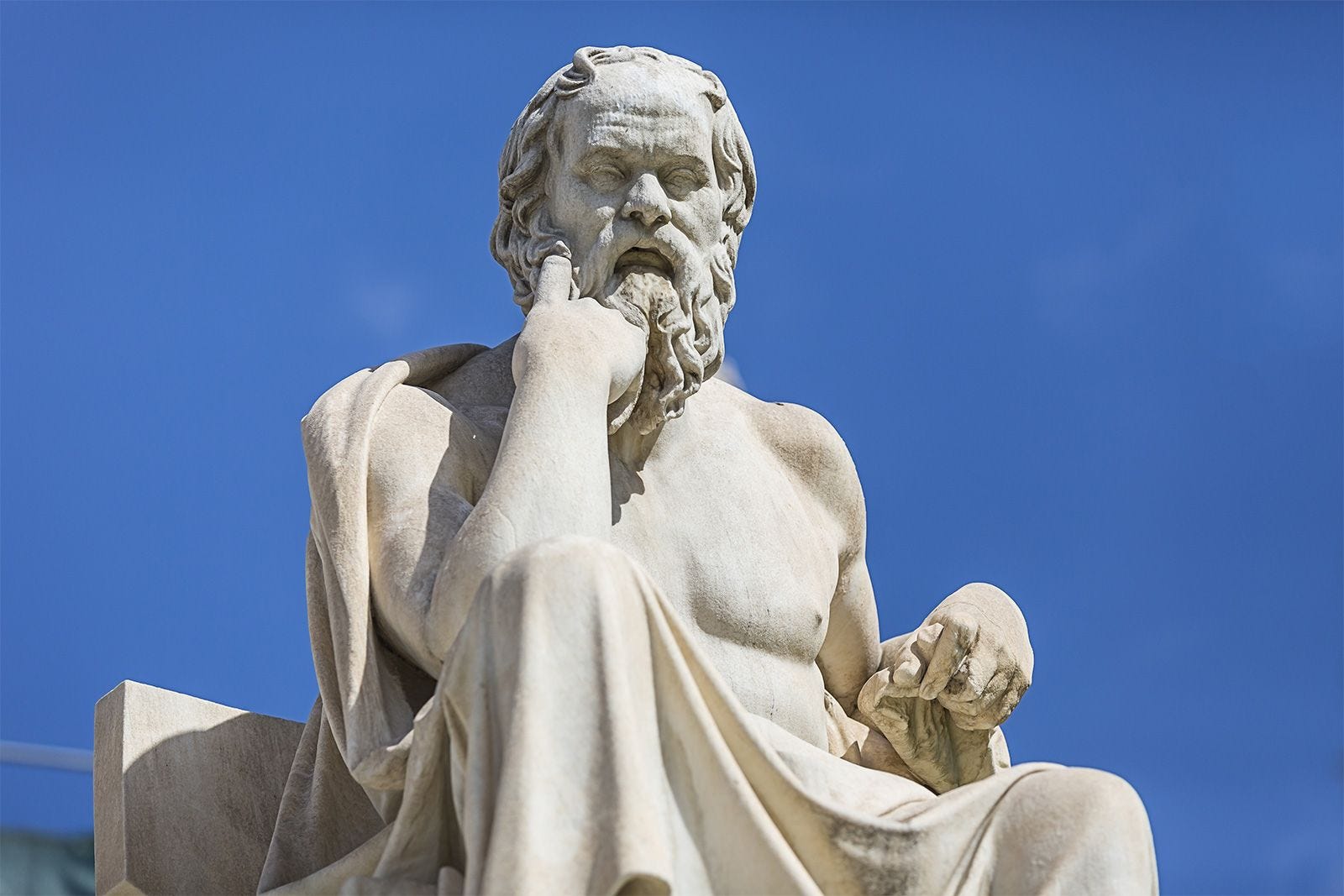
Corny or not, I do actually like this quote a lot. It hit me hard the first time I read it. I grew up branded a nerd and fit myself into that mould. I was a supremely unathletic, scrawny, sickly kid, and I was also supremely bookish and good at sitting still and writing stuff down. Under those circumstances, it doesn’t take much for a kid to start disregarding the things he’s got no apparent natural aptitude for, and gravitating towards things that not only come more naturally to him, but seem to be valued more. I would hazard a guess that many young boys experience the exact same dilemma, but in the exact opposite direction (their peer groups value athletic performance and it comes far more naturally to them than sitting still in a classroom, so they gravitate towards athletics).
I don’t think there’s necessarily anything wrong with letting kids follow their interests. What is a real shame, though, is when a kid (or anyone, really) places limitations on themselves to fit into a box. That was my experience. I preemptively discounted athletic opportunities when they came up throughout my teenage years because they weren’t in alignment with a self-concept that, at the time, seemed static — this tough, stone edifice that could not be cracked and had always been standing strong. “I’m not that guy.” That’s a powerful unconscious statement. I know many people can relate to this in plenty of different domains of life. Whether you didn’t apply yourself in science class because you “weren’t that guy” or you were a girl and pulled yourself out of certain pursuits because they “weren’t for you” or you gave up on the piano or archery or fucking basket-weaving because they were “not your thing” — you know what’s up here. Our self-concepts, by definition, are imprisoning things. To define yourself, you must define what you are not. The world needs to be a thing of contrasts, dualism. And this has enormous utility in day-to-day life, but it can also be profoundly limiting.
We’ve gone off the rails a little. Returning to the idea of physical training. I remember reading the so-called Socrates quote at a time when I was moving through academia and various research groups, and I was realizing that plenty of the best scientists and students I was encountering were well-rounded individuals — fit (sometimes jacked) people who valued their physical health just as much as their mental pursuits. It’s so simple looking back on it now, but this was genuinely destabilizing. I had, in many ways, raised up this self-concept as a defense for my ego. “I’m not an athletic guy? Fuck it, I’m a nerd and good at science — I don’t need to be good at sports stuff. It’s not for me.” Being faced with the reality, that not only could someone be well-rounded, but that physical training is actually instrumental in maximizing performance across the board, was a powerful realization. And Socrates, this paragon of cerebral living and nerding out, telling me that I had no right to sit around and disregard weight training and martial arts, was a wakeup call. I had to leave my ego at the door, look at things objectively, and start building.
I think physical training is vitally important for everyone. Our minds depend on it. We evolved as long-distance runners. Over thousands of years, every culture of humans on the planet developed some manner of sporting competition — maybe to train kids for combat or hunting, or maybe to just keep our minds and souls healthy, because is there at the end of the day any profound distinction between the mind, body and soul, or are they not all made of the same luminous stuff?
New age weirdness aside, I noticed immense changes in my personal life when I began training. Since 2022, I’ve gained nearly 30 pounds of weight, the majority of which is lean tissue. I’m still nowhere close to where I’d like to be (most people probably wouldn’t look at me and think I train much at all), but I am orders of magnitude stronger than I was as a 23-year-old. I sleep better. I process my emotions better. I feel better about myself. I am accustomed to pushing my body hard, and that helps me push through obstacles that aren’t made of iron and rubber. Above all, I am more grounded in my physical existence, and for a person who has historically struggled with anxiety, this is a huge boon. The immediacy of any physical practice is anathema to overthinking, and the mind running astray. I’m sure there’s plenty of neuroscience behind this, but the intuitive nature of it is clear to anyone who’s gone for a long walk to clear their head, or fought some demons on a bench press. You know who you are.
If there’s a point to any of this rambling, it’s this — there is a physical practice for anyone. Anyone. If a guy like me, so convinced that athletics are not for him, could find an all-encompassing passion for Brazilian jiu-jitsu and kickboxing that eventually led him to the weight room (I didn’t start lifting weights for health, you see. I started lifting because I was tired of getting smashed at BJJ practice. Who cares about health, man? Winning grappling rounds — that’s real shit), then I truly believe anyone can find a physical practice that they can wholeheartedly love and make a focal point in their life.
What’s yours? And if you don’t have one, where’s gravity pulling you? What’s something you’ve always wanted to try? Give it a shot. Because for what it’s worth, I actually disagree with Socrates a little bit here. You do have the right to be an amateur — so long as you’re trying.